.webp)
How Much Architecture an MVP Needs in 2026
In 2026, most MVPs fail not because the architecture is “too simple,” but because it’s built for an imagined scale instead of the first 100–1,000 real users. This article breaks down what architecture an MVP actually needs, what can wait, and which decisions are hard to change later. It’s written for non-technical founders who want to ship fast without creating a fragile product that collapses as soon as people start using it.

TL;DR: A good MVP architecture in 2026 is the smallest setup that stays reliable while you learn from real users.Design for change (modularity, observability, clear data boundaries), but don’t design for scale you haven’t earned yet.
The real question isn’t “simple vs scalable”
Founders often ask: Should we build it properly from day one? The problem is that “properly” usually means “for a future we haven’t validated.”
In practice, MVP architecture is about one thing: how expensive it will be to change your mind.
Your first version will change weekly. Features will be cut. Workflows will be rewritten. Pricing may shift. Sometimes even the core user role changes.
So the best architecture for an MVP in 2026 is not the one that can handle millions of users. It’s the one that lets you ship, measure, and rewrite fast without breaking everything.
If this mindset feels unfamiliar, it’s the same principle we apply in Web App Development for Startups: Architecture Basics for Non-Tech Founders.
What an MVP architecture must cover (even when you’re moving fast)
You can ship a lot with a lean stack — but there are a few foundations you should treat as non-negotiable.
1) One source of truth for data
Your MVP needs clarity on:
- where data is stored,
- who can access it,
- how it changes over time.
Messy data boundaries don’t just create bugs. They slow every future change because nobody trusts what will break.
2) Basic reliability (not enterprise reliability)
You don’t need five layers of redundancy — but you do need:
- predictable deployments,
- backups,
- error monitoring,
- a rollback plan.
Because the moment you get traction, downtime turns into churn.
3) Observability from the start
If you can’t see what users are doing, you’ll end up guessing what to build.
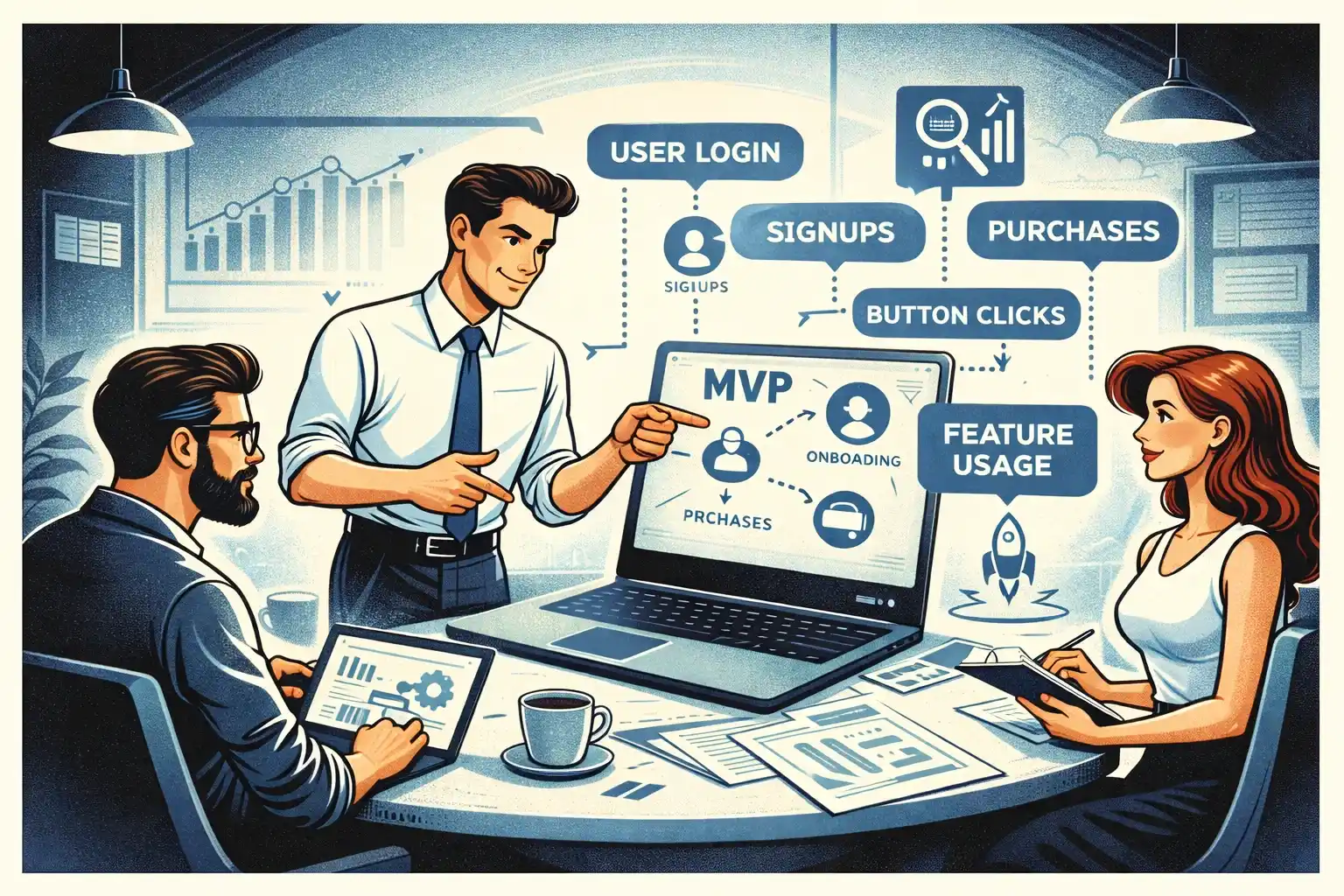
At minimum, you need events for activation and key actions, plus a way to spot issues quickly.
This connects directly to Your First Product Metrics Dashboard: What Early-Stage Investors Want to See.
4) Clear boundaries for “AI” if you’re using it
In 2026, many MVPs include AI features. That’s fine — but architecture must separate:
- deterministic logic (rules, validations, permissions),
- probabilistic outputs (AI suggestions),
- fallbacks when AI is wrong.
Otherwise you’ll ship a product that works only in demos.
What you should avoid in MVP architecture (even if it sounds smart)
Overengineering usually doesn’t look like “too many servers.” It looks like decisions that increase complexity before there’s evidence you need them.
Microservices “because we’ll scale later”
For most early MVPs, microservices create:
- more deployment points,
- more debugging paths,
- higher maintenance costs,
- slower iteration.
Unless you already have multiple teams building in parallel, this is usually a self-inflicted slowdown.
A custom backend “because we need full control”
Sometimes true. Often not.
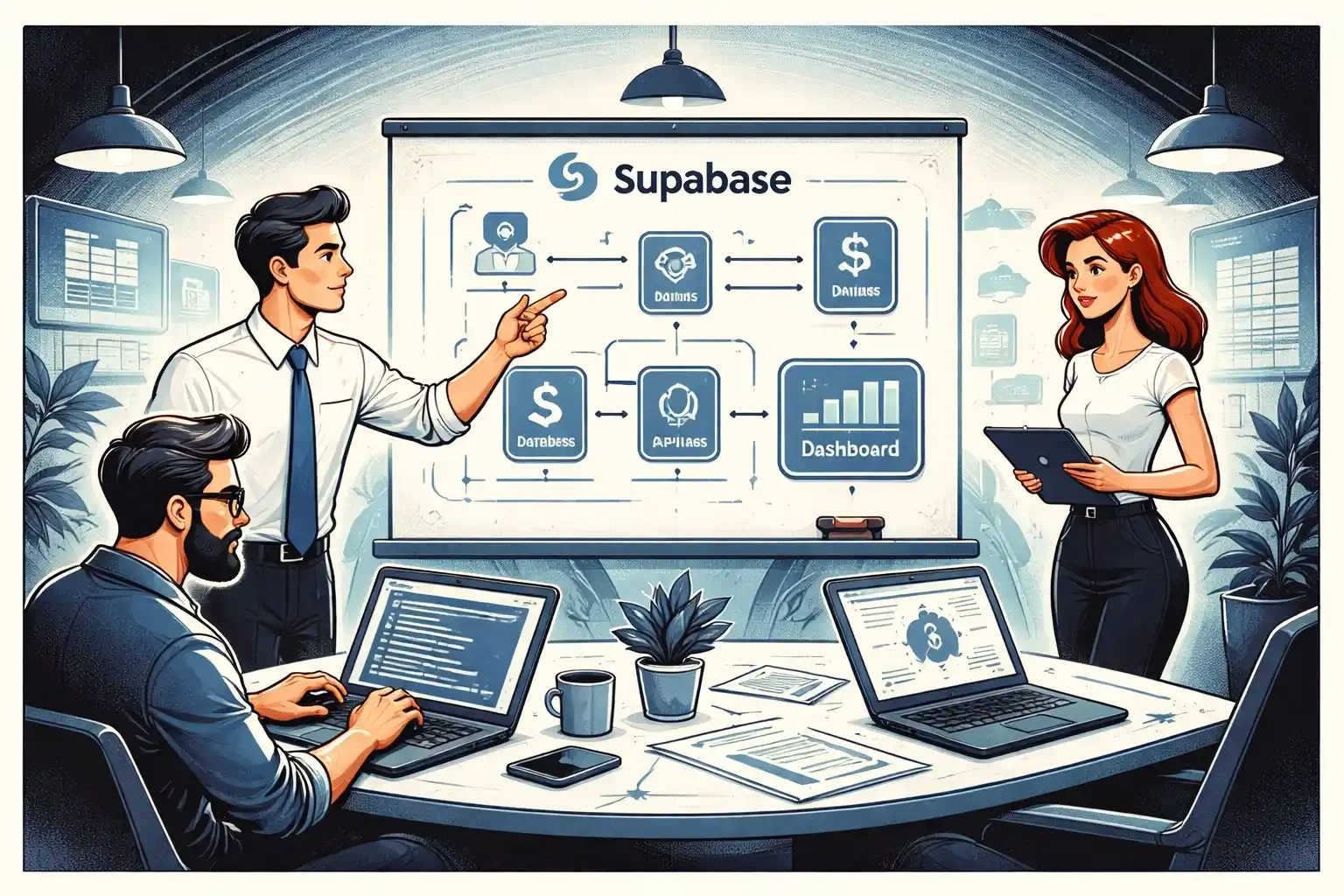
Many MVPs can run well with modern managed backends and a focused API layer — and that’s what keeps cost and time predictable.
If you’re choosing between mainstream options, Supabase vs Firebase for Your Startup MVP Backend gives a practical founder-level comparison.
Premature performance optimization
If your MVP is slow today, fix it.If it might be slow someday, don’t build an entire architecture around that fear.
Your first bottleneck is usually:
- product clarity,
- onboarding,
- retention,
- distribution.
Not database sharding.
The decisions that are hard to change later
Some architectural choices are expensive to reverse. These deserve early attention.
Authentication and roles
If your product has roles (buyer/seller, patient/provider, admin/user), define them cleanly from day one.
Role chaos becomes permission chaos. And permission chaos blocks growth.
Data model and naming
You don’t need perfect schemas, but you do need a coherent model:
- primary entities,
- relationships,
- what gets logged,
- what gets deleted.
A messy data model makes every feature slower to add.
Security basics
Even an MVP needs:
- proper access control,
- secure storage for secrets,
- sane defaults,
- minimal data collection.
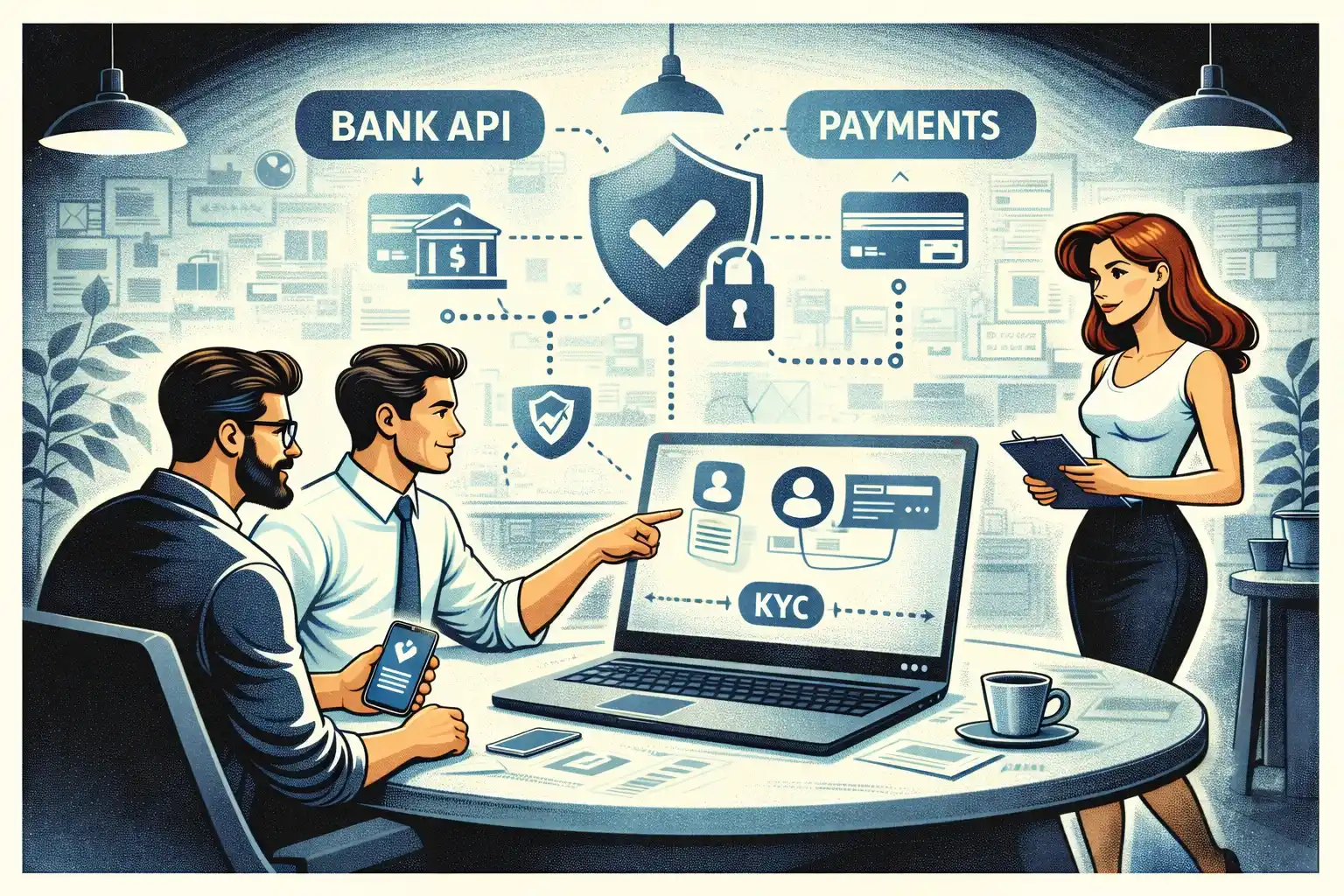
If you’re building in regulated areas, architecture becomes even more sensitive. A useful overview is Fintech App Development for Startups: MVP and Compliance Basics.
A simple way to think about MVP architecture in 2026
Here’s a founder-friendly approach that works well in practice.
Step 1: Define your “core workflow”
What is the shortest path that proves value?Example: “Create account - complete one action - see outcome - come back.”
Your architecture should protect that flow first.
Step 2: Map the riskiest assumptions
Usually one of these:
- users won’t complete onboarding,
- the workflow is too long,
- data quality is messy,
- pricing is wrong,
- integrations are harder than expected.
Build architecture to reduce the biggest risk first, not to satisfy a theoretical best practice.
This is why validation and scoping matter so much. If you want a tight framework for it, see Validate a Startup Idea Before Development: 5 Experiments That Work.
Step 3: Choose the simplest stack that supports iteration
Most MVPs in 2026 benefit from:
- a modern web framework,
- a reliable managed backend,
- clean auth,
- basic analytics,
- clear API boundaries.
If you’re tempted to add a “platform layer,” “workflow engine,” or “event-driven everything,” ask: Will this help us learn faster in the next 30 days?
Step 4: Add “escape hatches,” not complexity
Escape hatches are choices that keep change cheap:
- feature flags,
- modular components,
- clean interfaces,
- logging,
- admin tools (even minimal).
They don’t make the architecture complex — they make it survivable.
How to spot if your team is overbuilding
A quick founder checklist:
- They talk more about “future scale” than your first release.
- They propose microservices before you have product-market signals.
- They can’t describe the MVP scope in plain language.
- They can’t tell you what metrics define success in the first 14–30 days.
- They treat architecture as the product instead of a tool.
If you’ve been burned by this before, Outsource Development for Startups: Pros, Cons, and Red Flags is a good reset.
What “good” looks like in a real MVP build
A good MVP architecture in 2026 usually ships with:
- a working core workflow,
- clean data boundaries,
- sane auth and roles,
- monitoring and basic analytics,
- a deployment process you can trust,
- the ability to change scope without rewriting everything.
And the biggest signal: your team is willing to simplify.
Because MVP success is rarely blocked by missing architecture. It’s blocked by shipping too late.
Thinking about building a web or mobile app in 2026?
At Valtorian, we help founders design and launch modern products — with a focus on real user behavior, not overbuilt architectures that slow you down.
Book a call with Diana
Let’s talk about your idea, scope, and fastest path to a usable MVP.
FAQ
Do I need microservices for my MVP in 2026?
Usually no. Microservices make sense when you have multiple teams, clear boundaries, and proven load. For an MVP, they typically slow iteration.
What’s the minimum “architecture” an MVP should have?
Clear data ownership, reliable deployments, error monitoring, basic analytics, and clean auth/roles. Everything else depends on your product risk.
Should I build custom backend logic from day one?
Only if your core workflow truly depends on unique business logic. Otherwise, a managed backend plus a focused API layer is often faster and safer.
What’s the biggest architectural mistake founders make?
Designing for scale instead of designing for change. Most early products need flexibility more than performance.
How early should I think about scalability?
Early enough to avoid traps (bad data model, messy roles, no monitoring) — but not so early that you delay shipping. If you can’t ship to real users, scalability doesn’t matter.
How do I know if my MVP is “too fragile”?
If small changes cause unexpected bugs, deployments feel risky, or you can’t trace errors quickly, your architecture needs basic reliability and observability improvements.



















































.webp)




.webp)